IMF Resident Representative Dr. Adrian Alter Engages KNUST Economics Community on the 2026 Regional Economic Outlook for Sub-Saharan Africa
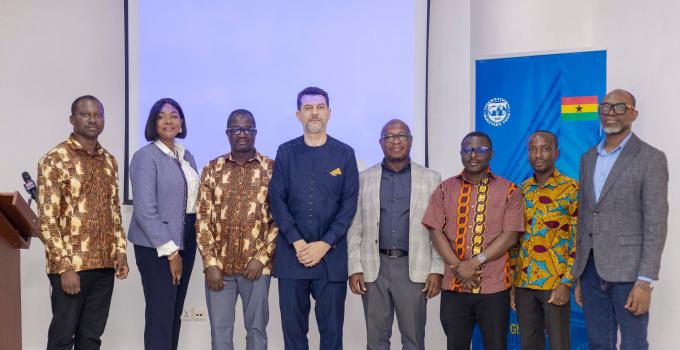
The Department of Economics at Kwame Nkrumah University of Science and Technology (KNUST) hosted Dr. Adrian Alter, the International Monetary Fund’s Resident Representative for Ghana, on June 30, 2026, for a seminar on the 2026 Regional Economic Outlook for Sub-Saharan Africa, titled “Hard-Won Gains Under Pressure.”
The event brought together faculty, postgraduate and undergraduate students, researchers, and guests to examine the region’s evolving macroeconomic landscape and the policy priorities needed to sustain growth amid heightened global uncertainty.
Presenting the outlook, Dr. Alter noted that Sub-Saharan Africa recorded its strongest economic performance in nearly a decade in 2025, underpinned by improved macroeconomic policies, moderating inflation, stronger external conditions, and better fiscal positions. He cautioned, however, that those gains remain vulnerable to emerging global shocks, particularly ongoing geopolitical tensions in the Middle East that have pushed up oil, gas, fertiliser, and shipping costs, clouding the region’s growth prospects.
The presentation outlined several policy priorities for African economies: maintaining price stability through credible monetary policy, strengthening fiscal discipline while protecting vulnerable populations, improving domestic revenue mobilisation, enhancing the efficiency of public expenditure, and accelerating structural reforms to support private-sector-led growth and economic diversification. Dr. Alter also stressed the importance of strengthening public financial management, deepening domestic financial markets, expanding digital financial inclusion, and harnessing digital technologies and artificial intelligence to lift productivity and public service delivery.
A lively interactive session followed, during which faculty and students engaged Dr. Alter on Ghana’s macroeconomic recovery, inflation dynamics, fiscal consolidation, monetary policy transmission, debt sustainability, exchange rate management, and the implications of declining official development assistance for African economies.
After the event, department members said the seminar provided timely, evidence-based policy analysis and practical insights into the region’s economic outlook. They reaffirmed the department’s commitment to fostering engagement between academia and international policy institutions to enrich teaching, research, and public policy discourse.
The Department of Economics extended its gratitude to Dr. Alter for the engaging and thought-provoking presentation and said it looked forward to deepening collaborations that advance evidence-based economic policy and research.